
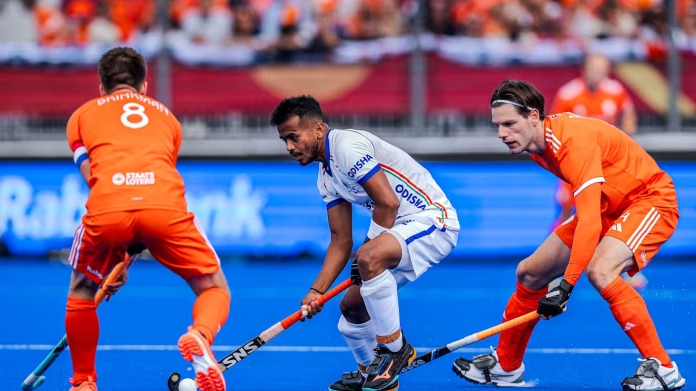
The hockey world is always excited to see the best national teams compete for international glory, and the 2026 edition of the FIH Hockey World Cup brings together elite men’s and women’s field hockey in a major global sporting event. Hosted jointly by Belgium and the Netherlands, the tournament takes place from 15 to 30 August 2026. With world-class players, passionate supporters, and competitive matches, the event offers a celebration of skill, teamwork, speed, and sportsmanship. Both host nations have strong hockey traditions and modern venues designed to welcome fans from around the world. The hockey world cup 2026 is especially significant because the men’s and women’s competitions are being held together, creating a shared international stage for 32 national teams. From the opening matches to the medal contests, the tournament showcases the growing popularity of field hockey and the determination of athletes competing for one of the sport’s most prestigious titles.
Hockey World Cup 2026: Key Details
The 2026 tournament is organised under the authority of the International Hockey Federation (FIH), the international governing body for field hockey. Belgium and the Netherlands are sharing hosting responsibilities, with matches scheduled in Wavre, Belgium, and the Amsterdam-Amstelveen area of the Netherlands. The competition features separate men’s and women’s tournaments, each involving 16 national teams. This combined format creates opportunities for supporters to experience two high-level international competitions during the same period.
The event is also an important opportunity for participating nations to measure their progress against the world’s strongest hockey teams. Coaches must balance attacking creativity with defensive discipline, while players need excellent fitness, communication, and tactical awareness. The host countries will benefit from home support, but they will also face the pressure of performing in front of demanding crowds.
|
Tournament detail |
Information |
|---|---|
|
Event |
FIH Hockey World Cup 2026 |
|
Host countries |
Belgium and the Netherlands |
|
Tournament dates |
15–30 August 2026 |
|
Men’s teams |
16 |
|
Women’s teams |
16 |
|
Main venues |
Wavre, Belgium, and Amstelveen, Netherlands |
|
Governing body |
International Hockey Federation (FIH) |
|
Competition format |
Separate men’s and women’s tournaments |
Tournament details are based on official FIH and event-organiser information.
Host Countries and Tournament Venues
Belgium and the Netherlands are well-established hockey nations with experienced players, strong domestic competitions, and enthusiastic supporters. Their joint hosting arrangement gives the tournament a distinctive European atmosphere while allowing matches to be staged in two different hockey destinations. In the Netherlands, the iconic Wagener Stadium in Amstelveen serves as a major venue. Belgium hosts matches at the Belfius Hockey Arena in Wavre, a purpose-built facility developed for the event.
The two venues provide a setting for international competition while highlighting the importance of investment in sporting infrastructure. For travelling fans, the event also offers opportunities to experience European culture alongside live hockey. Stadium atmosphere, fan activities, and the presence of supporters from different countries help make a World Cup more than a sporting contest. The host nations must also manage transport, security, ticketing, team facilities, and media operations to ensure a smooth experience for players and spectators.

Men’s Hockey World Cup 2026
The men’s competition brings together 16 national teams that have earned their places through the qualification system. The field includes the host nations and teams that qualify through continental championships, the FIH Pro League, and designated World Cup qualifying tournaments. Each team arrives with its own playing style, tactical strengths, and ambitions.
Men’s international hockey is known for its high speed, powerful hitting, quick passing, and demanding defensive transitions. Teams need to maintain their shape while switching rapidly from defence to attack. A single turnover can create a scoring opportunity, making concentration essential throughout every quarter. Penalty corners are also a major feature because specialist drag-flickers can turn a set-piece into a decisive goal.
For supporters, the men’s competition offers a chance to assess established hockey powers against ambitious challengers. Strong teams may rely on experienced international players, while emerging sides can use disciplined defending and counterattacking to challenge favourites. The tournament’s knockout stages are especially demanding because mistakes become more costly as the competition progresses.
Women’s Hockey World Cup 2026
The women’s competition is equally important to the overall tournament, with 16 national teams competing for the world title. Women’s international hockey continues to demonstrate technical quality, speed, tactical development, and impressive athletic ability. Teams combine creative attacking moves with structured defending, and successful performances often depend on how effectively players work together under pressure.
Modern women’s hockey features fast ball movement, intelligent off-ball running, accurate passing, and carefully organised penalty-corner routines. Goalkeepers play a particularly important role, making quick decisions and organising defenders during dangerous situations. Midfielders must cover large areas of the pitch, link defence with attack, and help control possession.
The World Cup also provides a major platform for women’s sport. International visibility can encourage young athletes to take up hockey, strengthen national development programmes, and inspire greater investment in coaching and facilities. For countries with established women’s hockey programmes, the event is an opportunity to demonstrate progress. For developing teams, competing against leading nations offers valuable experience that can support future international campaigns.
Participating Teams and Qualification Process
Qualification is one of the most important stages of any World Cup. National teams must perform well in their regional competitions or other recognised qualification pathways to secure a place in the final tournament. The FIH qualification framework for 2026 included automatic places for the host countries, selected Pro League pathways, continental qualification, and dedicated World Cup qualifying tournaments.
The final qualification events were scheduled in Santiago, Chile; Ismailia, Egypt; and Hyderabad, India, in early 2026. These tournaments gave teams another opportunity to compete for places at the global event. Hosting a qualifier in Hyderabad was particularly relevant for Indian hockey supporters, who could watch international teams compete on home soil.
The qualification process helps maintain a competitive balance while representing different hockey regions. European teams often bring considerable tactical depth, Asian teams are recognised for quick movement and technical ability, and teams from Oceania and the Americas add their own approaches to the game. African nations also contribute to the sport’s international development.
Tournament Format and Match Structure
The hockey world cup 2026 brings together 32 teams across the men’s and women’s competitions. Each competition has 16 participating nations, which are organised into groups for the initial stage before teams advance through the tournament according to the official competition regulations.
The group stage is important because teams need consistent results rather than relying on one outstanding performance. Coaches evaluate opponents, manage player workloads, and decide when to attack aggressively or protect a lead. Goal difference and other official tie-break criteria may become important when teams finish level on points, depending on the applicable regulations.
After the opening stage, the tournament moves towards decisive classification and knockout matches. These games determine which teams remain in contention for the title and which compete for their final positions. Semi-finals bring the strongest remaining contenders together, while the medal matches provide the climax of the competition.
Key elements of the format include:
-
Group-stage matches: Teams compete to improve their standing and progress.
-
Tactical preparation: Coaches analyse opposition strengths and weaknesses.
-
Knockout pressure: Teams must perform under the pressure of elimination.
-
Classification matches: Participating nations compete to establish their final positions.
-
Medal matches: The leading teams compete for the championship and podium places.
The official regulations determine the precise progression and tie-breaking procedures, so the tournament format should be assessed alongside the published competition rules.
Schedule and Important Stages
The tournament ran from 15 to 30 August 2026. Its schedule was designed to accommodate both men’s and women’s matches across the host venues, building towards the final stages during the closing days. As with major international tournaments, the fixture calendar was important for players, coaches, broadcasters, and supporters planning their viewing or travel.
|
Tournament stage |
Main purpose |
|---|---|
|
Opening matches |
Introduce the competing teams and begin the group competition |
|
Group stage |
Establish team standings and identify advancing sides |
|
Classification games |
Determine final positions for teams outside the title race |
|
Semi-finals |
Decide which teams advance to the championship matches |
|
Bronze-medal matches |
Determine third-place finishes |
|
Finals |
Crown the men’s and women’s world champions |
The exact match timings, results, and progression depend on the official tournament schedule and results. Supporters reviewing the event can use the published fixtures and match records to follow each team’s path through the competition.

Players and Teams to Watch
The World Cup attracts established international players as well as rising talents hoping to make a name for themselves. Although individual selections vary by country, several positions are particularly important when analysing performances.
Forwards are responsible for converting attacking pressure into goals. They need speed, accurate finishing, and the ability to find space inside the shooting circle. Midfielders provide the connection between defence and attack, helping teams retain possession and create opportunities. Defenders must anticipate passing lanes, challenge attackers, and prevent dangerous circle entries. Goalkeepers can change the course of a match through quick reactions and confident organisation.
Penalty-corner specialists also deserve attention because set pieces can be decisive in closely contested matches. Their timing, technique, and ability to read the goalkeeper’s movements may determine the outcome of a game. Rather than judging a player solely by goals scored, supporters can assess passing accuracy, defensive recoveries, movement off the ball, and contribution to the team’s overall structure.
India’s Interest in the Hockey World Cup 2026
India has a proud history in international field hockey, making the World Cup an important event for Indian supporters. The country has produced celebrated players and achieved significant success in Olympic hockey. Its hockey community continues to follow major international competitions closely, with particular interest in how the national teams perform against leading opponents.
India’s qualification campaign also attracted attention because Hyderabad hosted a women’s World Cup qualifying tournament in March 2026. The event brought international competition to Indian soil and provided local fans with an opportunity to experience high-level hockey.
Indian supporters generally look for strong defensive organisation, creative midfield play, effective penalty corners, and clinical finishing when assessing a team’s prospects. However, success at a World Cup depends on consistent execution across the competition. Even talented squads must adapt to different opponents, maintain fitness, and manage pressure during close matches.
The tournament also provides useful lessons for India’s hockey development. Analysing international tactics, goalkeeper performance, player rotation, and penalty-corner strategies can help coaches and young athletes understand the standards required at the highest level.
How to Follow Hockey World Cup News and Results
Fans who want to keep track of the tournament can focus on several types of information. Match results explain how teams performed, while group standings show the impact of wins, draws, and losses. Team statistics offer further insight into scoring efficiency, defensive strength, and set-piece performance.
For a more complete understanding of the competition, consider these points:
-
Review match summaries to understand how games developed.
-
Compare goals scored and conceded to assess overall team performance.
-
Follow penalty-corner conversion and defensive success.
-
Examine player contributions beyond goals and assists.
-
Check official announcements for squad updates, disciplinary decisions, and final standings.
Broadcasting availability differs by country, so viewers should check the arrangements applicable to their region. Highlights and match reports can also help supporters catch up on games they could not watch live.
Why the Hockey World Cup Matters
The Hockey World Cup is important because it brings together the leading national teams in a competition that tests technical ability, physical conditioning, and tactical intelligence. Success can strengthen a country’s sporting reputation and motivate the next generation of players. The tournament also gives emerging hockey nations a valuable opportunity to compete against experienced opponents and gain exposure on the international stage.
Hosting the event can generate wider benefits for local communities through tourism, employment, fan engagement, and investment in sporting facilities. Joint hosting by Belgium and the Netherlands also highlights the value of international cooperation in organising major competitions.
For the sport itself, the World Cup creates a platform for promoting hockey to new audiences. Exciting matches, outstanding individual performances, and close finishes can attract viewers who may not regularly follow the game. Increased visibility can encourage participation at schools and clubs and support the long-term development of the sport.
Conclusion
The hockey world cup 2026 brought the men’s and women’s international competitions together in Belgium and the Netherlands from 15 to 30 August. With 32 national teams across the two tournaments, the event showcased the importance of teamwork, tactical discipline, technical excellence, and competitive spirit. The host venues provided a setting for top-level hockey, while qualification pathways gave teams from different regions an opportunity to reach the global stage. For fans, the tournament offered a chance to assess established contenders, discover emerging players, and celebrate the development of international hockey. Its wider significance extends beyond medals, supporting the sport’s visibility, inspiring young athletes, and strengthening hockey’s global community.