
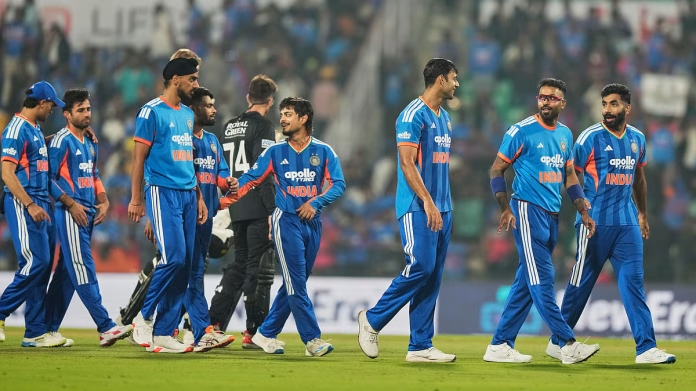
The India national cricket team vs New Zealand national cricket team match scorecard is an important resource for cricket fans who want to understand match results, individual performances, and the key moments that influence a contest between these two international sides. India and New Zealand have built a competitive cricketing rivalry across Test matches, One Day Internationals (ODIs), and Twenty20 Internationals (T20Is). Each format offers a different challenge, requiring players to adapt their batting strategies, bowling plans, and fielding approaches.
India are widely recognised for their batting depth, spin-bowling options, and strong performances at home. New Zealand are known for their disciplined bowling, athletic fielding, and ability to perform under pressure. When these teams meet, the scorecard provides a clear record of how the match developed, from the opening overs to the final result. Whether you follow a bilateral series, an ICC tournament, or a major knockout match, understanding the scorecard helps you look beyond the final score and appreciate the individual contributions that determine the outcome.
Understanding the Match Scorecard
A cricket scorecard presents the essential information from a match in an organised format. It usually includes each team’s total runs, wickets lost, overs faced, batting performances, bowling figures, extras, fall of wickets, and the final result. Depending on the format and competition, it may also show the toss winner, playing elevens, venue, match officials, and player-of-the-match award.
For fans searching for the India national cricket team vs New Zealand national cricket team match scorecard, identifying the correct fixture is the first step. The teams may play multiple matches in the same series or tournament, and their results can differ significantly between formats. A Test match can last several days, an ODI normally features 50 overs per side, and a T20I generally allows 20 overs per side. Checking the match date, venue, format, and innings ensures that you interpret the right statistics rather than confusing figures from separate encounters.
India vs New Zealand Scorecard Overview
The following table explains the main details commonly included in a match scorecard. It is a guide to the information readers should check rather than a record of a particular completed match.
| Scorecard detail | What it tells you |
|---|---|
| Match format | Whether the fixture is a Test, ODI, or T20I |
| Venue | The stadium and location where the match takes place |
| Toss result | Which captain won the toss and the decision made |
| First innings | Runs scored by the team batting first |
| Second innings | Runs scored by the chasing team or the opposing side |
| Batting figures | Runs, balls faced, boundaries, and strike rate |
| Bowling figures | Overs, maidens, runs conceded, and wickets |
| Extras | Additional runs from wides, no-balls, byes, and leg-byes |
| Fall of wickets | The score and stage at which each wicket was lost |
| Match result | Winning team, margin, tie, or draw where applicable |
| Player of the match | The player recognised for an outstanding contribution |
This information makes it easier to compare the two teams and understand how a match unfolded. A large total does not always guarantee victory, as pitch conditions, chasing pressure, and bowling performance can change the result. Similarly, a low-scoring contest may feature excellent bowling and a close finish.
India’s Batting Performance
India’s batting performance is often a major talking point in matches against New Zealand. The top order is responsible for establishing a solid foundation, while the middle order must maintain momentum and respond to wickets at crucial stages. Opening batters aim to negotiate the new ball, rotate the strike, and take advantage of scoring opportunities. Middle-order players may need to rebuild an innings after early dismissals or accelerate when a strong platform has been established.
When analysing an Indian innings, readers should examine individual runs, balls faced, boundaries, strike rates, and partnerships. A batter scoring quickly can change the direction of a T20I, while a patient innings can be especially valuable in a Test match. In ODIs, balancing steady accumulation with controlled acceleration is often essential.
The number of wickets remaining also matters. A team that loses several wickets early may struggle to reach a competitive total, even if one batter produces an impressive score. Conversely, a strong partnership can restore control and create opportunities for a late-innings surge. The scorecard helps identify these turning points and shows which Indian players made the greatest contributions.

New Zealand’s Batting Performance
New Zealand’s batting approach depends on the match situation, the playing conditions, and the type of bowling they face. The team has often relied on a combination of technically sound top-order batters and adaptable middle-order players. Against India’s varied bowling attack, New Zealand batters must manage both pace and spin while avoiding unnecessary risks.
A scorecard analysis should consider whether New Zealand built partnerships, maintained a healthy scoring rate, and protected wickets for the final overs. In limited-overs cricket, a steady start can provide the platform for aggressive finishing. In Test cricket, patience and concentration become particularly important because batters must manage longer spells, changing pitch conditions, and sustained pressure.
Individual scores should always be considered alongside the circumstances in which they were made. A batter who scores 40 runs during a difficult chase may provide a more valuable contribution than a higher score made when the result is already largely decided. The fall-of-wickets section and the team’s overall scoring rate help readers assess these performances more accurately.
Bowling Analysis: India vs New Zealand
Bowling figures are among the most useful sections of a cricket scorecard. They show how many overs a bowler delivered, how many runs were conceded, and how many wickets were taken. Depending on the format, economy rate, maiden overs, and dot-ball pressure can also help explain a bowler’s impact.
India may use a combination of fast bowlers, swing specialists, wrist spinners, and finger spinners according to the conditions. New Zealand may respond with seam movement, disciplined lengths, changes of pace, and spin options. The effectiveness of each approach depends on factors such as weather, pitch behaviour, boundary dimensions, and the batters at the crease.
When reviewing a match, look beyond the number of wickets. A bowler who concedes very few runs can restrict the opposition and create pressure for other bowlers to take wickets. Another bowler might concede more runs but dismiss a dangerous batter at a decisive moment. The complete bowling figures, combined with the match situation, provide a more balanced assessment of each team’s performance.
Important Statistics to Check in the Scorecard
Readers can use several statistical indicators to understand the contest more clearly:
- Total runs: Shows the final batting contribution of each team.
- Wickets lost: Indicates how successfully a team protected its batting lineup.
- Run rate: Measures how quickly a team scored during its innings.
- Batting strike rate: Shows the speed at which an individual batter scored.
- Bowling economy: Reveals how many runs a bowler conceded per over.
- Partnerships: Help explain how batters built or recovered an innings.
- Extras: Identify additional runs that did not come directly from a batter’s scoring shots.
- Fall of wickets: Shows when the innings lost momentum or entered a difficult phase.
These figures are most useful when read together. For example, a high run rate combined with several wickets lost may indicate an aggressive but risky innings. A moderate run rate with wickets in hand may suggest that a team is preparing for a strong finish.
Head-to-Head Rivalry Across Formats
India and New Zealand have competed in all three major international formats, and their rivalry has produced different tactical challenges in each one.
Test Matches
Test cricket rewards patience, technique, stamina, and the ability to adjust to changing conditions. Seam movement can be particularly influential in New Zealand, while spin and varied pitch conditions can shape contests in India. Scorecards from Test matches should be examined across both innings, with attention to lead margins, follow-on possibilities, partnerships, and bowling workloads. A match can also end in a draw when time runs out before either side secures victory.
One Day Internationals
ODIs require teams to manage a longer limited-overs innings while preserving wickets for acceleration. Batting partnerships, middle-over scoring, and death-over bowling often determine the final result. A useful scorecard analysis compares each side’s run rate, wickets remaining, and performance during the final ten overs.
Twenty20 Internationals
T20Is are shorter and often feature aggressive batting, tactical bowling changes, and high-pressure finishes. Strike rates, boundary counts, dot balls, and economy rates are especially important. A small difference in the final overs can separate the winner from the losing team, making the final score and key bowling figures essential reading.
How to Identify the Match’s Turning Point
A turning point is a moment that significantly changes a team’s chances of winning. It could be an early wicket, a major partnership, a spell of economical bowling, or a late burst of runs. The scorecard helps readers locate these moments by showing the sequence of wickets, individual contributions, and scoring progress.
For example, if a team loses three wickets in quick succession, its innings may shift from building a competitive total to rebuilding under pressure. Alternatively, a late partnership between two lower-order batters may add valuable runs that transform a modest total into a challenging target. In a close chase, a bowler taking a wicket just before the final overs may force the batting team to change its strategy.
To analyse a match properly, compare the score at key stages, identify which players were involved, and consider the required run rate or remaining wickets. Match context is important: the same score can represent a comfortable position in one format and a difficult situation in another.
Why Fans Follow Match Scorecards
Match scorecards are useful for casual viewers, cricket enthusiasts, fantasy cricket followers, sports writers, and analysts. They provide a quick way to review the result without watching the entire match. They also allow readers to compare player performances, identify consistent contributors, and understand how team strategies evolve over time.
For fans following India and New Zealand, scorecards offer a reliable structure for discussing batting form, bowling effectiveness, fielding contributions, and captaincy decisions. They can also support historical comparisons, provided that the match date, venue, and format are checked carefully. Official scorecards are particularly valuable because they help avoid mistakes involving player names, innings totals, wickets, and results.
Conclusion
The India national cricket team vs New Zealand national cricket team match scorecard offers more than a final result. It provides a detailed view of the batting, bowling, partnerships, and decisive moments that shape an international cricket contest. By checking the format, innings totals, individual performances, bowling figures, and fall of wickets, fans can understand why one team gained the advantage and how the match developed.
India and New Zealand bring different strengths to Test matches, ODIs, and T20Is, making every fixture an opportunity to examine tactics and individual skill. For accurate analysis, always use the scorecard for the specific match you want to review and verify the final result before drawing conclusions. A careful reading of the statistics makes following this competitive rivalry more informative and enjoyable.